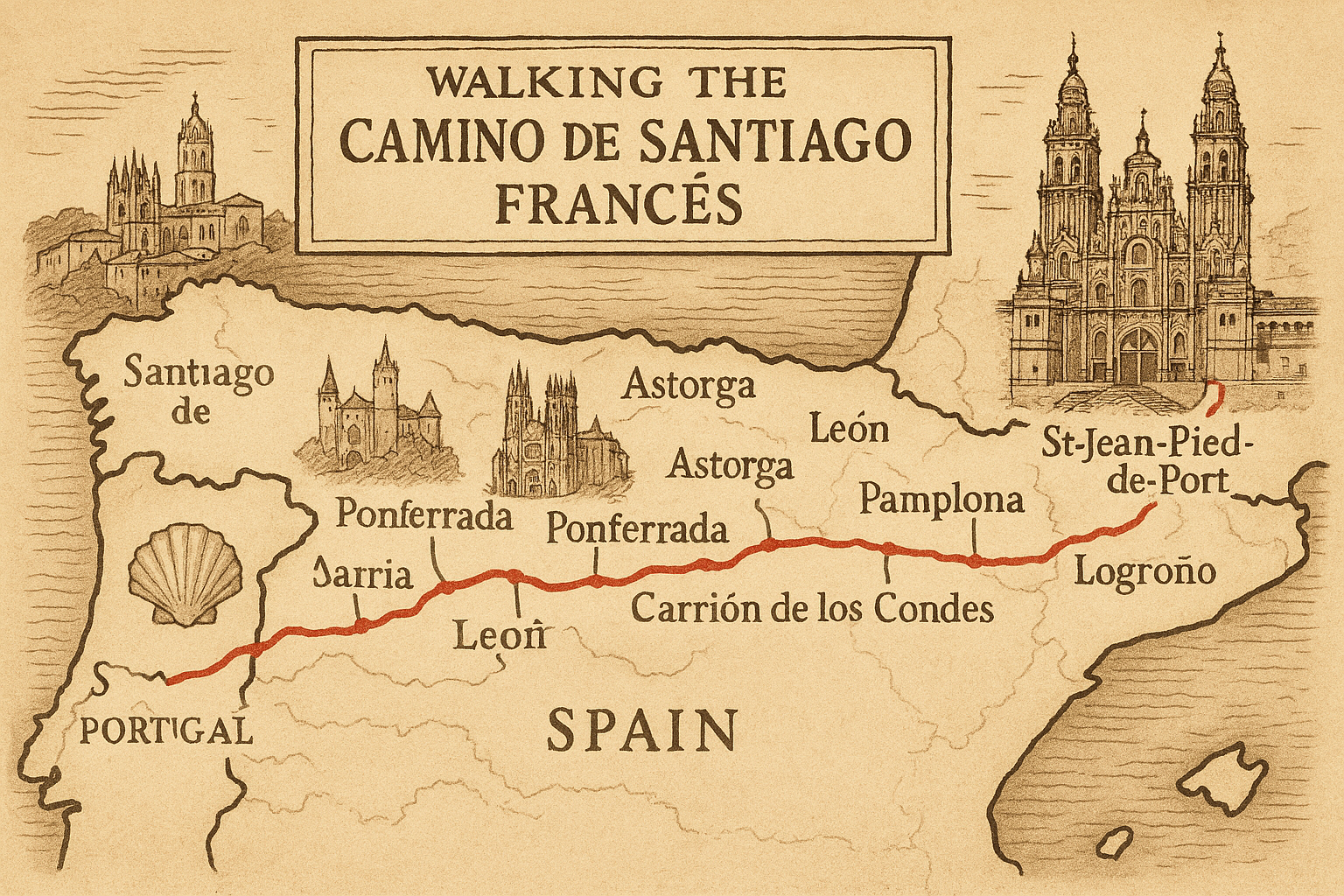
About the Camino
The Camino de Santiago is not just a hike; it’s a spiritual journey that attracts thousands of travelers from all over the world. The Camino is quite diverse in what it has to offer. This is true, particularly, because it has existed and has been walked for hundreds of years. It is believed strongly, by most pilgrims, that in the tomb at Santiago Compostela lie the bones of the apostle Saint James.
Before the Christian era, an early Roman trade route stretched along this region of the world which became a convenient route for the devoted to use on their new pilgrimage to Santiago. King Alfonso II of Asturias was the first to make the holy walk in the 9th century. By the 10th century, it was established as one of the three great pilgrimages of the Christian world with the proclamation of Pope Alexander VI.
From these early times, the Camino de Santiago crossed various independent kingdoms such as the Kingdom of Asturias, the Kingdom of León and the Kingdom of Navarre. With the 1469 AD marriage of Queen Isabella of Castile and King Ferdinand II of Aragon, the regions of the Iberian Kingdoms began to come together to form the modern Kingdom of Spain. You may remember that these monarchs employed a young man to sail west to find a short-cut to the trade routes in 1492. His name was Christopher Columbus.
The Cathedral of Santiago de Compostela had apparently lost track of the apostle’s bones for centuries after trying to protect them from looters. However, while some 19th century excavations were being done under the altar of the church, St. James’ bones were rediscovered. Pope Leo XIII confirmed the authenticity of the relics and the modern age of the Camino de Santiago began. Improvements continued to be made and in 1970 the historic walking route began to be marked. By the 2000s, one can run across many indicators of the trail while walking. Yellow arrows and scallop shell symbols are found along the way with other variations on stone cairns, wooden posts, tree markings and, occasionally, the red sword-shaped Cruz de Santiago can be seen, the Cross of Saint James.
I will travel to the area, and after a few days, begin my journey on May 4th. I can’t wait to walk by churches that are hundreds of years old. You can be sure I will not walk pass many without going inside to explore my favorite pieces of architecture, old churches. Some of the centuries old chapels and cathedrals along the Way, have hosted Christian worship for 1000 years or more. I will surely slip into a few, be seated, and enjoy to wondrous silence of these old buildings.
Leave a Reply